
On the Domestication of Artificial Intelligence
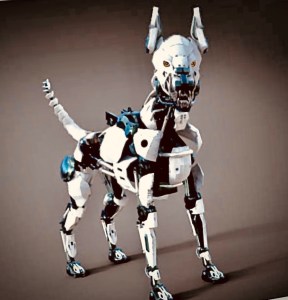
Dogs have been called man’s best friend, but this bond was not a gift from nature; it was an invention. The modern dog is a human creation, sculpted from wild wolves through thousands of years of selective breeding. It is worth remembering that wolves, before we shaped them into companions, were feared as monsters—dangerous predators lurking at the edge of firelight, the stuff of nightmares and folklore. The same creature we now invite into our homes and call family was once hunted, trapped, and reviled.
Today, we find ourselves in a strikingly familiar moment. Many people regard artificial intelligence with that same primal unease—as something alien, threatening, and beyond our control. Yet some technologists argue that what we are witnessing is not merely the emergence of a new tool but the early stage of a new kind of partnership.
Jerry Meng, founder of Kindroid, suggests that a kind of “speciation event” may already be under way as humans and AIs begin to coexist. “They’re going to be our friends, confidants, lovers, strangers—they’re going to be everything,” he said. “They’re going to be on the subway with you. To me, it’s already a foregone conclusion.”
A similar view is expressed by Mustafa Suleyman, Vice President of AI at Microsoft, who has suggested that artificial intelligence may ultimately resemble the emergence of a new kind of companion species. As he put it, “AI should best be understood as something like a new digital species. Now, don’t take this too literally, but I predict that we’ll come to see them as digital companions, new partners in the journeys of all our lives.”
Whether or not one accepts this framing literally, it captures an important point: we are not merely using these systems—we are shaping them.
In this sense, we are engaged in a similar act of creation with artificial intelligence as our ancestors undertook with wolves. While many fear AI as a digital boogeyman, it may be more accurate to view it as something we are beginning to domesticate—a technological partner whose development we shape and which will inevitably shape us in return, just as dogs did for our ancestors.
The parallel lies in co-evolution and utility. Early humans did not domesticate wolves for companionship alone. They formed a symbiotic partnership based on survival: wolves provided protection and hunting assistance, while humans provided food and shelter. Over generations we selectively bred them to enhance their natural abilities, creating specialized partners for herding, guarding, and retrieving. Dogs became extensions of our physical capabilities.
However, the functional role of dogs has shifted. In a modern world where few of us need a retriever to hunt dinner or a mastiff to guard the cave, dogs have transitioned primarily into emotional companions. Their purpose is now largely social.
Artificial intelligence, in a sense, fills the functional gap that dogs once occupied. In the digital age, survival depends less on physical prowess than on our ability to process information, manage complexity, and navigate an overwhelming landscape of data.
This is where AI increasingly enters the picture. It is being “bred,” in a technological sense, to perform cognitive tasks we cannot handle alone. Large language models sift through enormous datasets to synthesize knowledge. Algorithms help manage logistics networks, assist doctors in interpreting medical images, and automate routine administrative work.
Just as the dog once extended humanity’s physical reach, AI now extends humanity’s intellectual capacity. It is, in effect, the herding dog of the information age, helping us manage the vast flock of data that would otherwise overwhelm us.
Of course, the comparison is not perfect. Dog domestication unfolded slowly across thousands of years, while artificial intelligence is evolving within decades. And unlike dogs, advanced AI systems may eventually exceed human cognitive abilities in certain domains.
In fact, wolves exceeded human physical abilities in many ways, which is precisely what made them useful partners. If AI could not provide capacities beyond our own, its utility would be questionable. These differences matter. Yet the central dynamic—humans shaping a powerful new partner while simultaneously adapting to it, a process evolutionary biologists would recognize as coevolution—remains strikingly similar.
This is why the “evolve together” framework is so important. The nature of the AI we create will inevitably reflect our own intentions and incentives.
A dog trained with patience and care becomes a loyal companion; one bred or conditioned for aggression becomes dangerous. Similarly, algorithms trained on biased data or deployed without ethical oversight can amplify inequality.
As Cathy O’Neil argues in Weapons of Math Destruction, poorly designed algorithms can become “weapons of math destruction,” reinforcing social inequities at scale. The real boogeyman, in other words, is not the technology itself but the potential for human negligence in its creation.
For that reason, we should approach artificial intelligence not with fear alone but with the responsibility of a caretaker. Our goal should be to guide its development with the same care humanity eventually applied to its oldest domesticated partner.
If we succeed, this new creation may earn its place beside us—not as a monster at the edge of the firelight, but as a partner helping us navigate the complexity of the digital age.
⸻
References
O’Neil, Cathy. Weapons of Math Destruction: How Big Data Increases Inequality and Threatens Democracy. Crown, 2016.
Wiener, Anna. “Love in the Time of A.I. Companions: Some people now have an A.I. bestie. Some have a husband. Some have three.” The New Yorker, 9 March 2026.
Suleyman, Mustafa. “What Is an AI Anyway?” Transcript. Microsoft AI commentary, 4 May 2024.
 Tipozorro